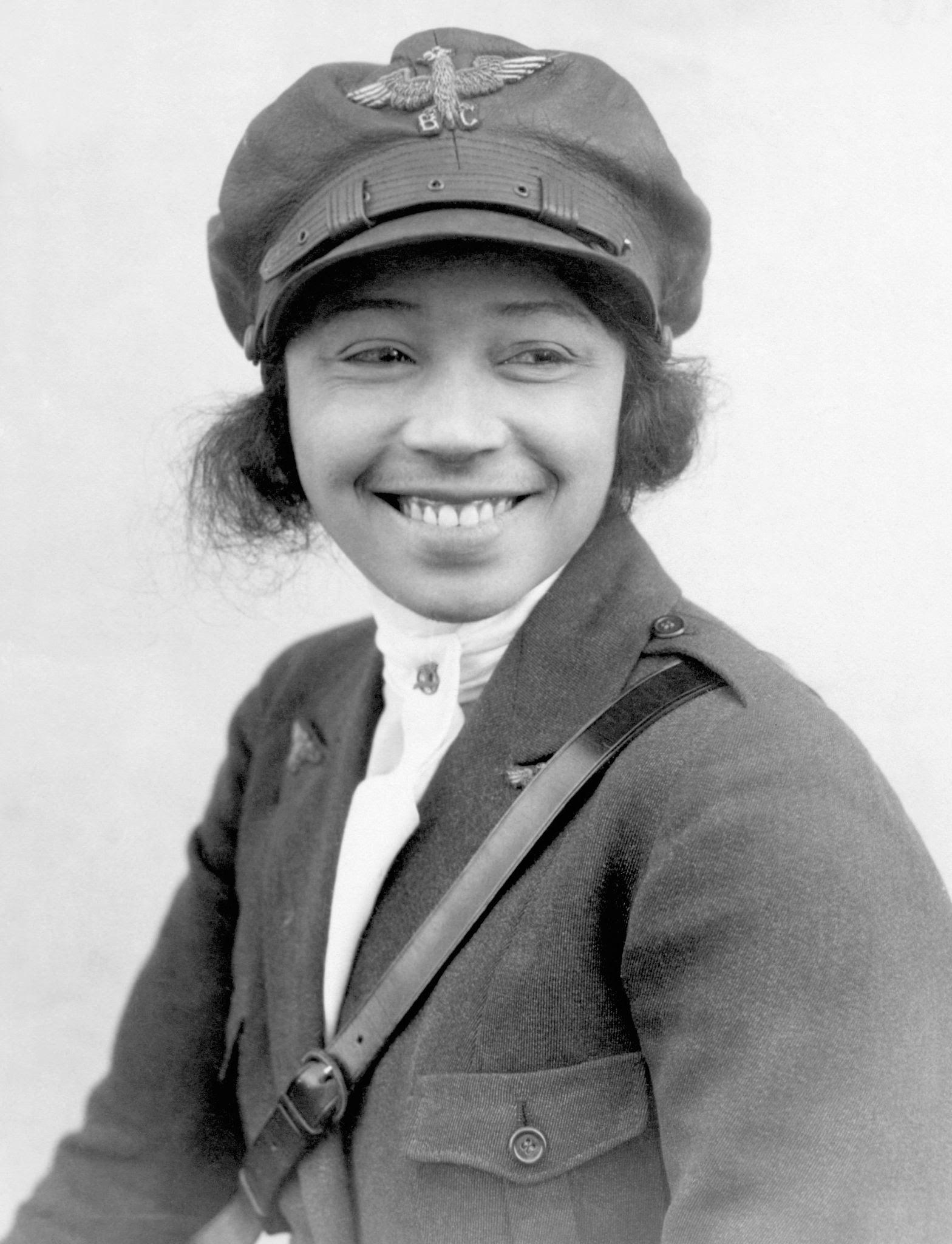
Biography
Elizabeth "Bessie" Coleman was an American civil aviator. She was the first African-American woman and first Native American to hold a pilot license, and is the earliest known Black person to earn an international pilot's license.
Archive beta: biographies are source-linked; map, timeline, context, date, and coordinate metadata may be approximate or under review.
What this means
Reviewed items have a source behind them. Approximate items are useful context, not final proof. Needs source and beta review labels mark places where the archive is still checking the trail.
Elizabeth “Bessie” Coleman was an American civil aviator. She was the first African-American woman and first Native American to hold a pilot license, and is the earliest known Black person to earn an international pilot’s license. She earned her license from the Fédération Aéronautique Internationale on June 15, 1921
Due to discrimination in the United States, however, she went to France to attend an aviation school to become a pilot. In 1921, she became the first American woman to obtain an international pilot’s license. Coleman came back to the United States and became a stunt pilot. She also raised money to start a school to train African American aviators, hoping to afford them opportunities that were not then available in the U.S. Coleman traveled across the country performing in air shows as a stunt pilot. She gave speeches and showed films of her air shows in theaters and schools to raise funds for the cause. Audiences were fascinated by her performances of “loop the loops” and figure 8’s in the sky. She toured Europe as well as the US, performing shows and giving lessons while encouraging African Americans to learn aviation. Coleman’s ultimate dream was to own a plane and create a flight school for African Americans. Coleman returned to Chicago in 1922 as the triumphant “Queen Bess, Daredevil Aviatrix”
She arranged an airshow in California to celebrate the opening of a new fairground. However, moments after she took off from Santa Monica for the Los Angeles fairgrounds, her motor stalled at 300 feet. Her newly purchased plane nose-dived, smashing into the ground. She survived the crash but was badly injured with a broken leg, a few cracked ribs, and cuts on her face. Battered and bandaged but unwilling to feel defeated, Coleman sent the following telegram from her hospital bed to her friends, “TELL THEM ALL THAT AS SOON AS I CAN WALK I’M GOING TO FLY! AND MY FAITH IN AVIATION AND THE USEFUL OF IT WILL SERVE IN FULFILLING THE DESTINY OF MY PEOPLE ISN’T SHAKEN AT ALL.”
Coleman was killed in 1926 during an aerial show rehearsal. Her barrier-breaking life, determination, and impressive career accomplishments continue to provide inspiration for others to this day. Pastor Junius C. Austin delivered the funeral oration, saying of Bessie, “This girl was one hundred years ahead of the Race she loved so well, and by whom she was least appreciated.” An African American newspaper in Dallas remarked upon her death that “there is reason to believe that the general public did not completely sense the size of her contribution to the achievements of the race as such.” Another paper reminded its readers, “Whether they take to it or not, Miss Coleman has taught our women that they can navigate the air, and like all pioneers, she has built her own monument.”
Although she died at the age of 34, her legacy continues to inspire. In 1931, the Challenger Pilots Association, a group of pioneering Black aviators, flew over Lincoln Cemetery at Kedzie Avenue and 123rd Street and dropped flowers on Bessie’s grave. Until they were too old to fly, the members regularly repeated the gesture. Each year, bright-colored blooms floated in the air where, like Bessie said, there is no prejudice (Grossman). Later in 1995, the “Bessie Coleman Stamp” was made to commemorate all of her accomplishments. And then in 2023, the US Mint released a Bessie Coleman quarter as part of the American Women Quarters Program. Mae Jemison, who in 1992 became the first African American woman to go into space, wrote that she “wished I had known her while I was growing up, but then again I think she was there with me all the time.” In one way Coleman was indeed with her when she left Earth. Jemison carried a picture of Coleman with her into space, flying far higher than Coleman ever dreamed. Coleman’s intelligence, strength and determination continues to inspire younger generations of African American women.
- Lifespan
- 1892-1926
- Nationality
- American
- Occupations
- Aviator
- Era
- Early 20th Century
- Born
- 1892 Needs source
- Died
- 1926 Needs source
- Tags
- American, Early 20th Century, Aviator
- Themes
- Global History